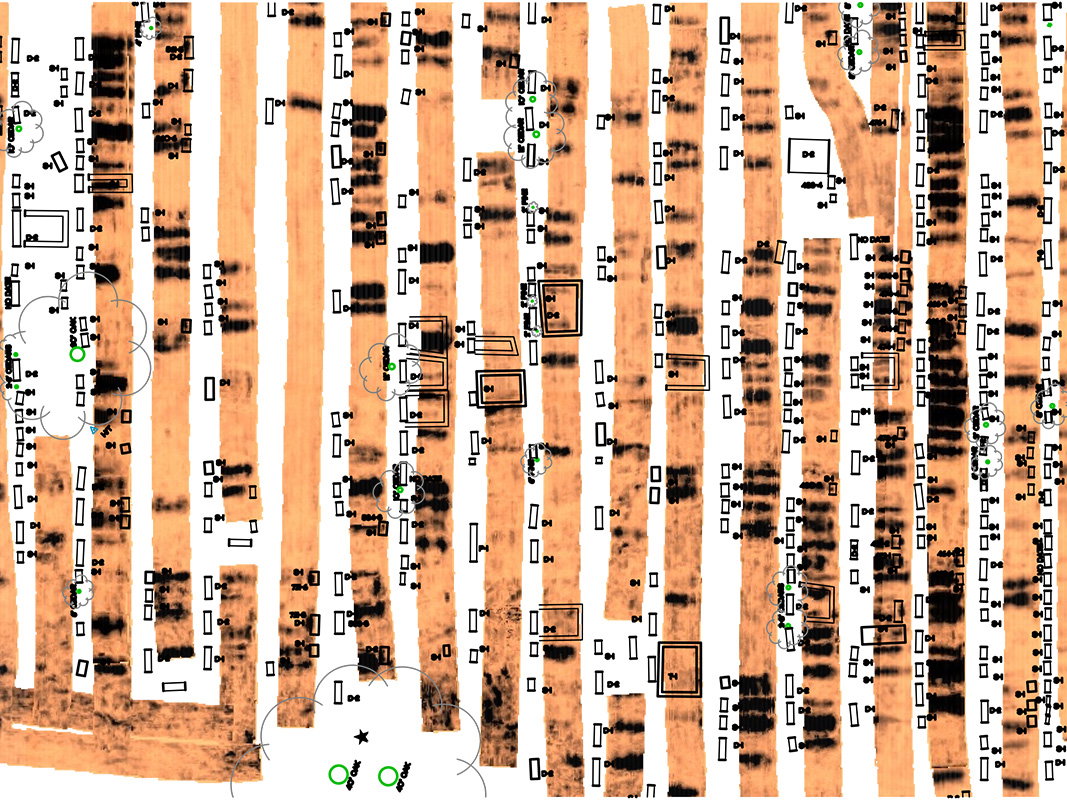
A process that creates 3D imagery of the ground subsurface
The lack of accurate infrastructure mapping has resulted in the loss of billions of dollars annually, in addition to needless physical harm. Infrastructure documentation is notoriously inadequate, and accidents often occur when workers cut lines without being aware of their existence (gas, sewer, steam, electricity, etc.). Designed by Alan Witten, Computer Assisted Radar Tomography (CART) is intended to solve these problems by making the invisible visible. CART is a patented combination of hardware and software that creates spatially accurate, high-resolution 3D imagery of the shallow subsurface from zero to ten feet below grade. Computer video files are created using a rapid-fire ground-penetrating radar antenna, a survey grade robotic laser tracking system, and patented image-processing software. In these files, utility infrastructure, and other subsurface features can be seen and may be extracted and rendered in CAD or GIS.
Hardware, software
Subsurface characterization: subsurface utility engineering, utility design and construction, environmental site assessment, forensic investigation, roadbed/bridgedeck assessment, UXO detection
Reduces risk, cost, damage, service interruptions, loss of life, etc. normally associated with lack of adequate and/or accurate subsurface characterization
American Society of Civil Engineers Standard 38-02
Not applicable in areas with highly-conductive soils (e.g. Great Salt Lake area), limited depth of penetration
Alan Witten
Witten Technologies Inc.