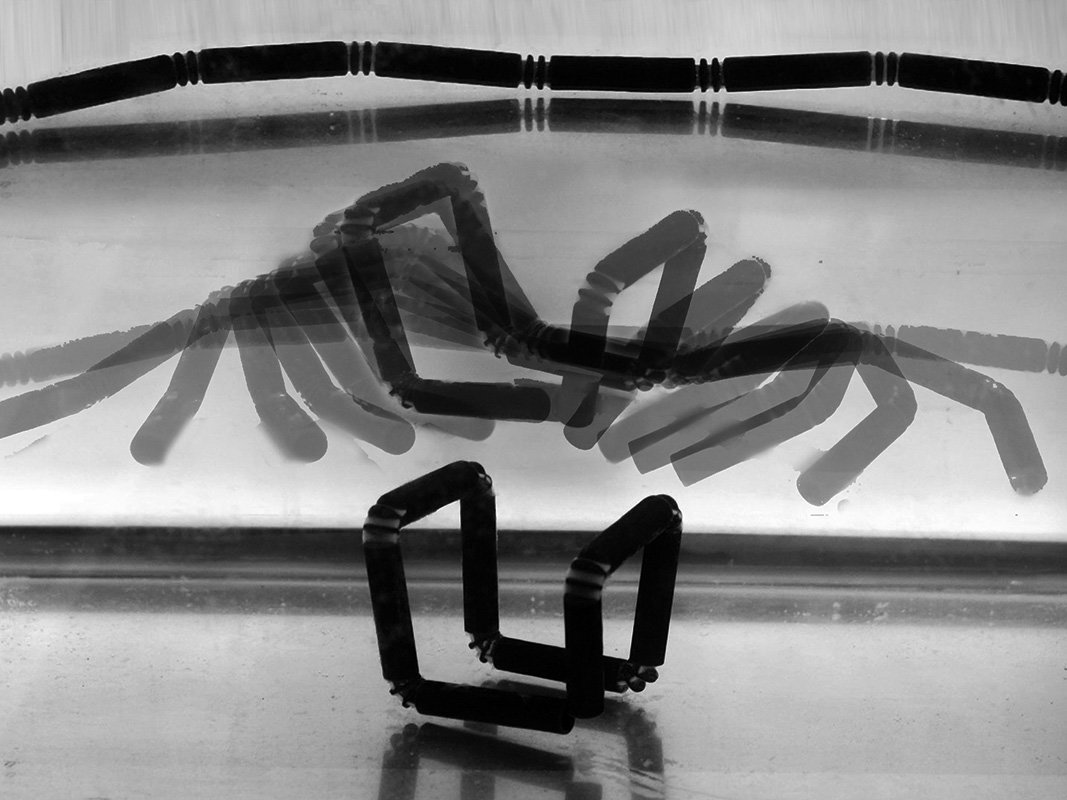
Multi-material shape change
4D Printing is a method for printing customizable smart materials that transform over time. Developed through a collaboration between MIT’s Self-Assembly Lab, Stratasys, and Autodesk, 4D Printing employs the Stratasys Connex printer to create multimaterial objects that can shape-shift immediately after printing. This transformative process enables enhanced functionality in materials, including sensing, actuation, and assembly. Possible uses include robotic approaches without the requirement for mechanical systems, in addition to responsive apparel, objects, or surfaces that can shift according to user-based or environmental needs. The Self-Assembly Lab creates multimaterial prints that consist of single strands or flat plates that morph into sophisticated three-dimensional objects when activated via water, light, heat, or another energy source. The key to 4D Printing is geometry. A hydrophilic polymer that is activated by water can provide the necessary expansion capabilities, for example, but the resulting form must first be designed with knowledge of the material’s behavior.
Hydrophilic polymer or another active component, rigid polymer or another inert material
Self-assembling structures, responsive garments, adaptive products
Hydrophilic material expands to 150 percent of its original size in water; prototype strands of (30 cm), 18” (46 cm) length; Hilbert curves of 14’ (4.3 m) and 50’ (15 m) length
Low energy construction
Requires an energy input for activation
Automated assembly of buildings and products from multi-material surfaces, improved worker safety and reduced construction errors
Skylar Tibbits
Massachusetts Institute of Technology Self-Assembly Laboratory