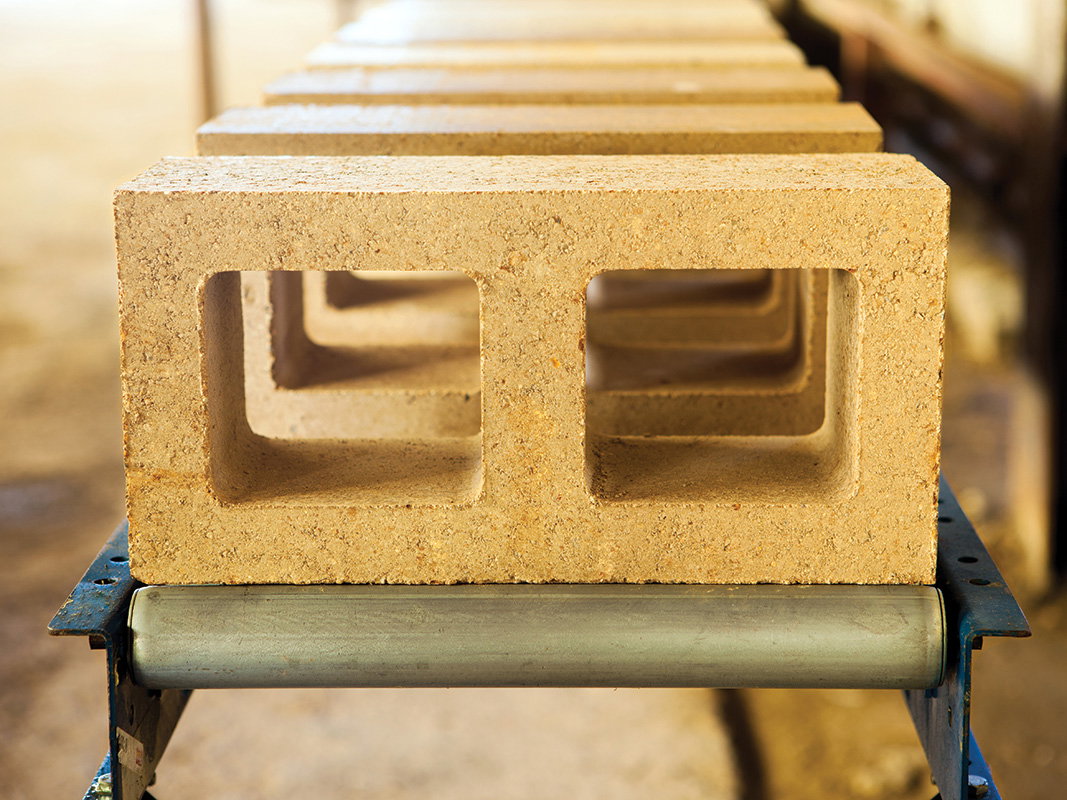
Cement-free concrete masonry unit
Watershed Block is an ecologically responsive and attractive replacement for the traditional concrete block (CMU), one of the most commonly used building materials. Watershed Materials, a technology start-up in Napa, California supported by the National Science Foundation, began development of Watershed Block in 2011. The company reduces the cement in structural masonry with an ultra-high-compaction manufacturing process that mimics the way stone is formed in nature, along with novel designs that take advantage of the aluminosilicates found in aggregates around the world. Watershed Materials initially reduced the cement by 50 percent, but further materials and manufacturing refinements enabled the complete elimination of cement. The manufacturer accomplishes the removal of cement with several mix designs that explore the geopolymerization of natural aluminosilicates and the reuse of industrial waste products to form unique binding combinations.
85-95% locally sourced recycled aggregates, 5%-15% cement free binders including geopolymers and lime/slag/aluminosilicate blend—or 5%-10% ordinary cement
Weight bearing structural wall systems (same as traditional concrete block)
Same as traditional concrete block (CMU): 4 x 8 x 16” (10 x 20 x 41 cm), 6 x 8 x 16” (15 x 20 x 41 cm), 8 x 8 x 16” (20 x 20 x 41 cm)
Cement reductions between 50% and 100% compared with traditional CMU; reductions in material transportation and water consumption
ASTM C90
Not suitable for areas with high freeze-thaw cycles
Reduction or elimination of energy-intensive cement from the ubiquitous concrete block
David Easton, Jose Muñoz, Joe Dahmen, Taj Easton
Watershed Materials