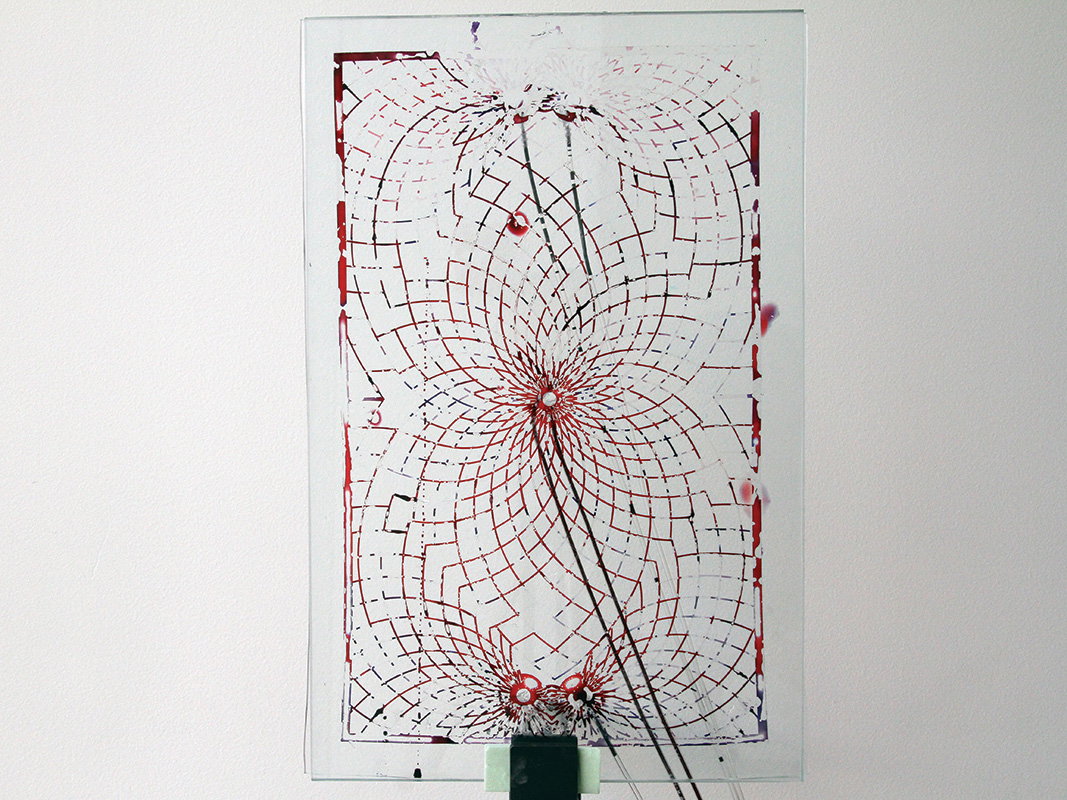
Responsive membrane window
Hydrogels are polymeric materials capable of retaining large quantities of water within three-dimensional networks. Researchers at the MIT Media Lab sought to explore the hydrophilic-hydrophobic phase transition in hydrogels, which occurs slightly above room temperature, in a new form of glazing. The Vascular Skin window demonstrates the mechanical and optical transformations that happen at this phase transition, including permeability, swelling, and visual modification—thus allowing light and view control that responds to the ambient temperature. In this way, the Vascular Skin project presages the possibility of fully active building surfaces and products.
Glass, hydrogels, tubing
Windows, glazed partitions, temperature-responsive surfaces
Vary
Opportunities for passive solar thermal control
Building envelopes that imitate the capillary behavior of biological skin
Neri Oxman, Benjamin Hutton
Massachusetts Institute of Technology Mediated Matter Group