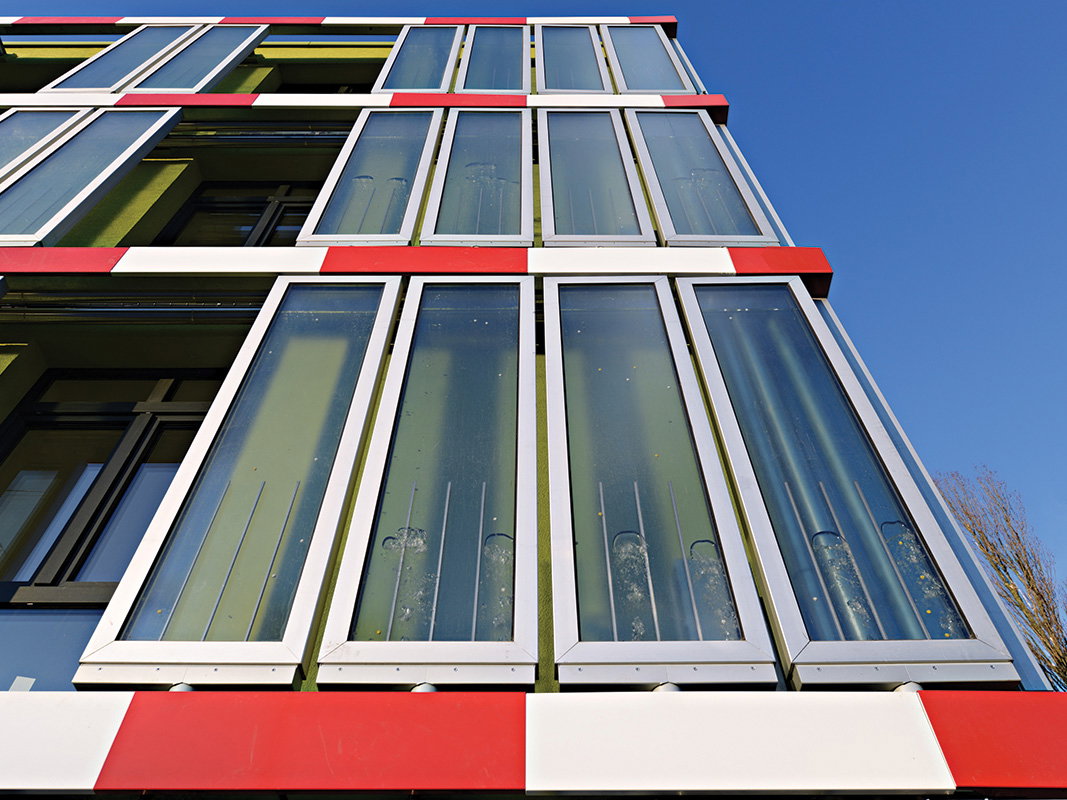
Bioreactor facade system
SolarLeaf is the world’s first bioreactive facade. Developed by Arup engineers in collaboration with the Strategic Science Consult of Germany and Colt International in a building designed by Splitterwerk for the 2013 International Building Exhibition in Hamburg, the algae-infused curtain wall system generates renewable power from algal biomass whose growth is encouraged by the sun. The system transports mature algae and heat within a closed loop to a building energy management center, which harvests the algal biomass via floatation and the heat via a heat exchanger. Because of its integration with building infrastructure, the energy management center utilizes any excess heat to provide hot water and heat to the building. Furthermore, the bioreactive facade functions as a dynamic shading device. The portions of the building exposed to the greatest intensity of sunlight experience the most algal growth—and hence, the maximum degree of shading.
Four layers of argon-insulated glass, water, algae culture, growth medium, plastic scrubbers, compressed air, inflow and outflow pipes
Building envelopes, renewable energy generation, exterior shading
Standard bioreactor measures 8’-2" x 2’-4” (2.5 x 0.7 m)
Photobioreactor process supplies heat and hot water from the cultivation of biomass, automatic shading conserves building energy consumption
In situ tests conducted at the BIQ house, Hamburg, 2013
Maximum operating temperature of 104˚ F (40˚ C), requires routine inspection and maintenance
Cultivation of living organisms for optimizing building operations processes, reduced reliance on fossil fuels, incorporation of energy-harvesting and mechanical systems as primary elements of the building facade
Jan Wurm
Arup Deutschland GmbH