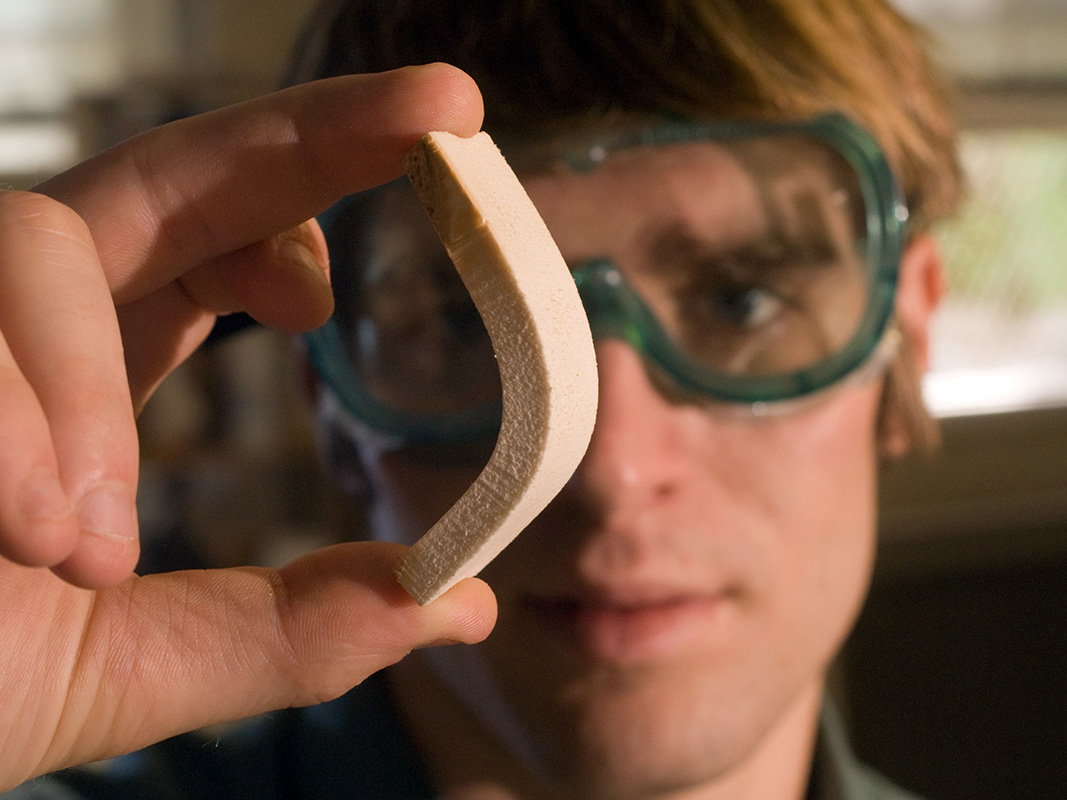
Mycological biomaterial
Mycoply board is a mycological biomaterial that is actually grown in a few months. It has properties similar to balsa wood and can be easily formed when saturated, yet will hold shape once dried. Athough balsa wood is biodegradable and natural, it is not easy renewable and disrupts its local environment when harvested. Mycoply, however, is rapidly renewable, grown using agricultural byproducts, and does not interrupt its surrounding ecosystem. Mycoply can replace core materials such as balsa, honey comb, or a variety of petrol foams for wind turbine blades, boat hulls, lightweight vehicle panels and many other applications. Mycoply also represents a low-embodied-energy manufacturing process as the material self assembles at room temperature and pressure in the dark. Additionally, its performance is superior in many ways to current structural core materials due to the ease in which it may be bent and formed. MycoPly reduces waste as it is grown to near-net shape and does not require post-processing.
Chitinous polymer
Boat hulls, wind turbine blade cores, light weight vehicle panels
Size varies according to application, can be grown to near net shapes; can be formed at 30% moisture, holds form when dried
100% natural, rapidly renewable (grows in months), biodegradable, low embodied-energy manufacturing process, grown from waste materials, locally produced
ASTM Standards: D3501-05a: Standard Test Methods for Wood-Based Structural Panels in Compression; D3500-90: Standard Test Methods for Structural Panels in Tension; D3043-00: Standard Test Methods for Structural Panels in Flexure
Edward Browka
Ecovative Design