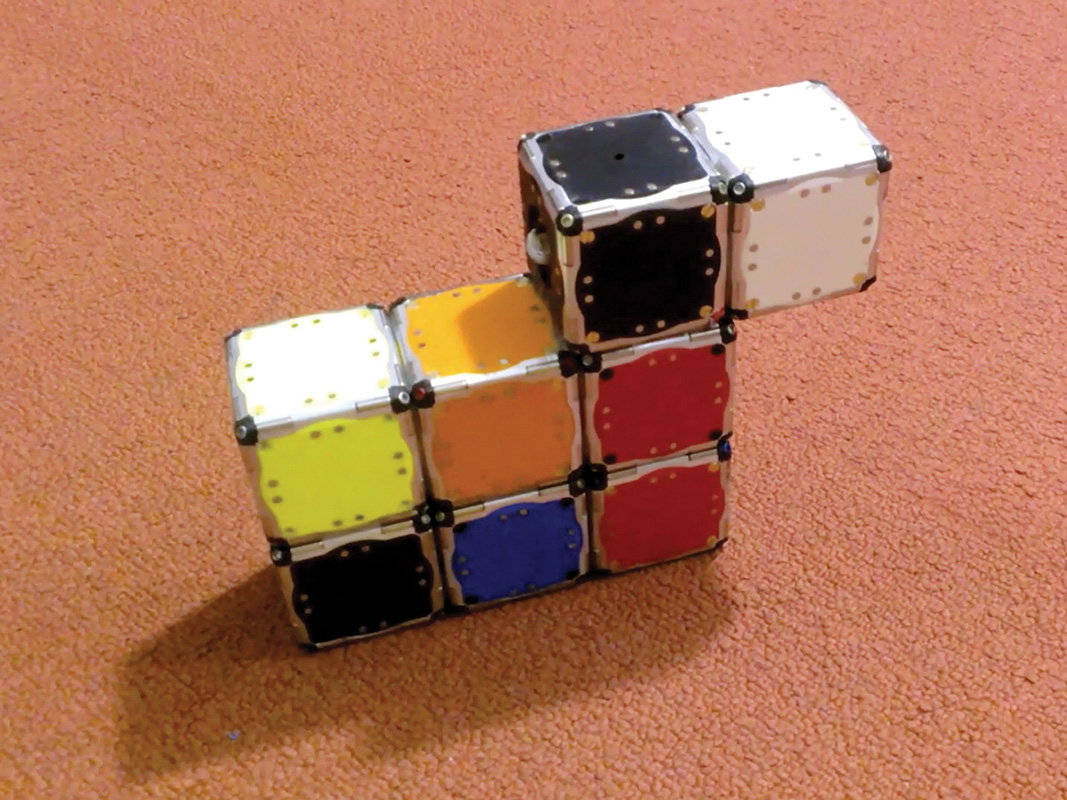
Self-assembling robotic cubes
M-Blocks are simple cubic robots that propel themselves through space without any conspicuous moving parts. Developed by scientists at MIT’s Computer Science and Artificial Intelligence Laboratory, M-Blocks can push, spin, or roll across a surface. They can climb one another to make three-dimensional structures and even jump from one position to another. M-Blocks’ seemingly magical capabilities are enabled by cleverly hidden mechanics. Each cube includes an internal flywheel that creates angular momentum when it brakes, as well as a battery for power and a radio for communication. The modules use a combination of surface magnets and edge magnets to join precisely with their neighbors, and can form elaborate lattice-like structures collectively. Although commands are now sent remotely, the researchers’ goal is to impart the modules themselves with mobility intelligence so that they can make autonomous decisions based on environmental conditions. The animate cubes could repair structures, self-construct scaffolding, or mobilize within zones that are unsafe for humans.
Beveled aluminum frame, flywheel, brushless motor controller, braking mechanism, electronics, radio, battery, face magnets, edge magnets, face plates
Structural repair, self-configuring scaffolding, self-assembling furniture, environmental monitoring and building in hazardous conditions
1 15/16" x 1 15/16" x 1 15/16" (50 x 50 x 50 mm)
Motion, endurance, material surface tests
Modules only contain a single, unidirectional actuator, and are not yet truly autonomous as they must receive algorithm commands via radio
Mobile, self-assembling robots will extend construction capabilities beyond the factory floor, enabling structural repair and automated construction—particularly in challenging conditions
Daniela Rus, John Romanishin, Kyle Gilpin
Massachusetts Institute of Technology CSAIL