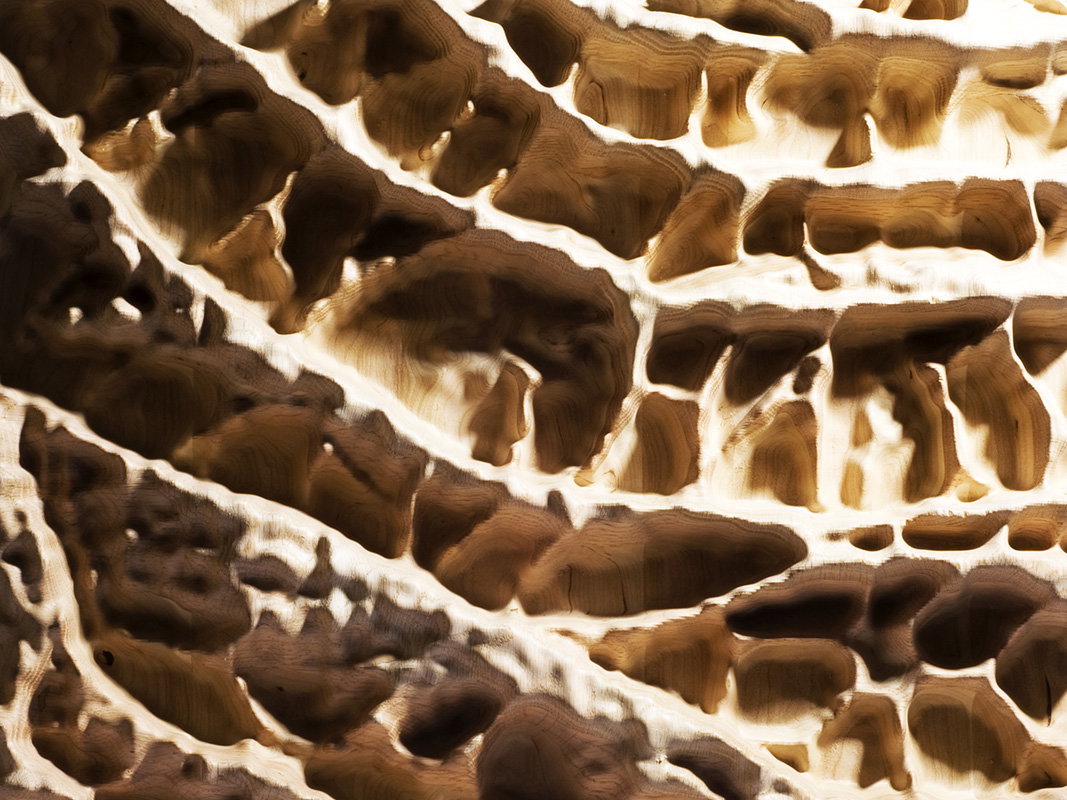
Anisotropic textured surface
Neri Oxman visualizes, analyzes and reconstructs 2D natural micro-structural tissues into 3D macro-scale prototypes by computing hypothetical physical responses. She uses a computational application to determine material behavior according to assigned properties and performance such as stress, strain, heat flow, stored energy and deformation due to applied loads and temperature differences. The interaction between the directional morphology of the specimen and the tensor direction produce physical effects that emphasize the tissue’s spatial texture in different ways. She then reconstructs the tissue using a CNC mill and multiple types of wood. Anisotropic in nature, grain directionality and layering are informed by the analysis resulting in laminated structural composites which respond to given ranges of energy and loading conditions.
CNC milled laminated oak and cherry wood
Advanced surface design and fabrication for product and architectural design involving structural specifications and stiffness properties
Custom sizes are constrained by net bed-size of 490 x 390 x 200 mm (19.3 x 15.4 x 7.9 inches)
Natural composite usage for effective stiffness
Currently not for exterior use, custom sizes are constrained by milling bed-size
"Oxman, Neri"
MIT Media Laboratory