Flying machine-enabled construction
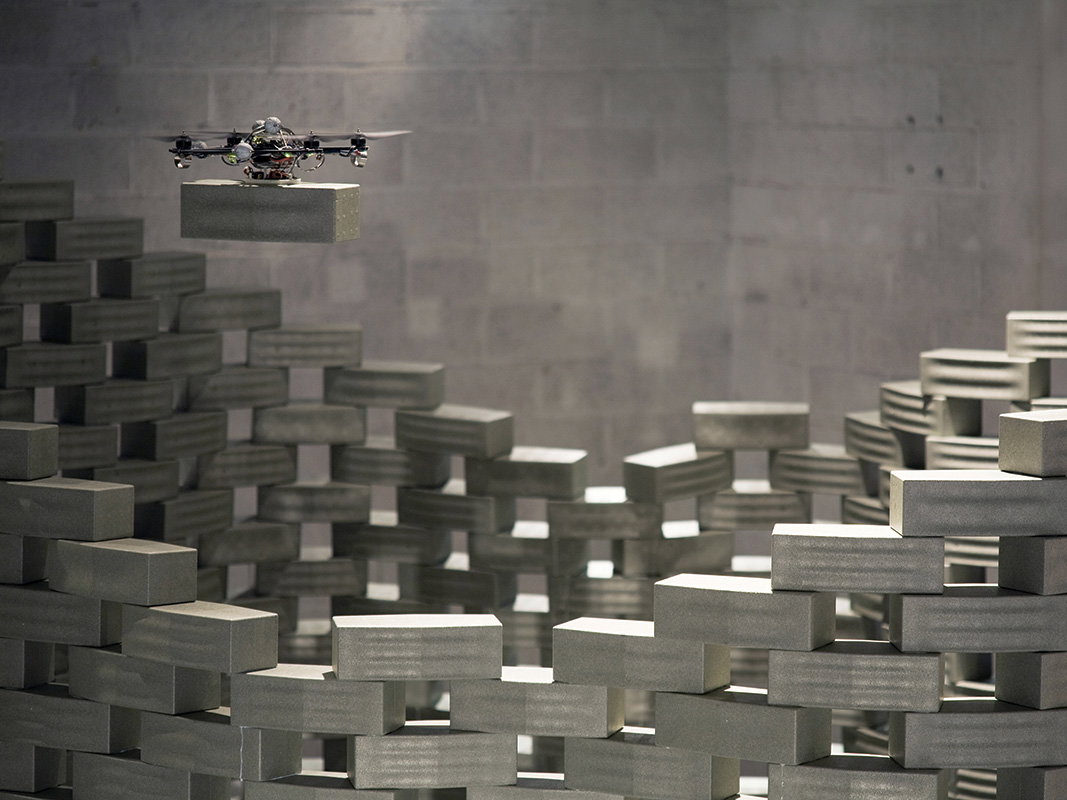
Flight Assembled Architecture is a process in which flying machines construct prototype building structures. Developed by ETH Zürich professor Raffaello D’Andrea and architecture firm Gramazio Kohler Architects, Flight Assembled Architecture employs software-controlled flying robots to place individual foam bricks in order to construct a large open-weave structure. Imagined as a scale representation of a 1,969'-tall (600-m) towering city for 30,000 inhabitants, the installation consists of 1,500 prefabricated polystyrene foam modules and stands 19.7' (6 m) high and 11.5' (3.5 m) in diameter at 1:100 scale. The quadrotor helicopters required several days of continuous flight to build the megastructure simulation. The potential to use flying machines for building construction has many compelling benefits, such as ensuring human safety and precision of craft.
Quadrotor helicopters, polystyrene foam building modules
Automated construction
Initial assembly made of 1500 modules, 19’-8” (6 m) high x 11’-6" (3.5 m) feet in diameter
Working prototype installed at FRAC Centre Orléans
Weight poses a challenge to air-based building construction; hence the need to prioritize lightness
Digitally automated, drone-based building construction would increase worker safety and enhance the ability to construct complex geometries
Raffaello D'Andrea, Fabio Gramazio, Matthias Kohler
ETH Zurich Institute for Dynamic Systems and Control