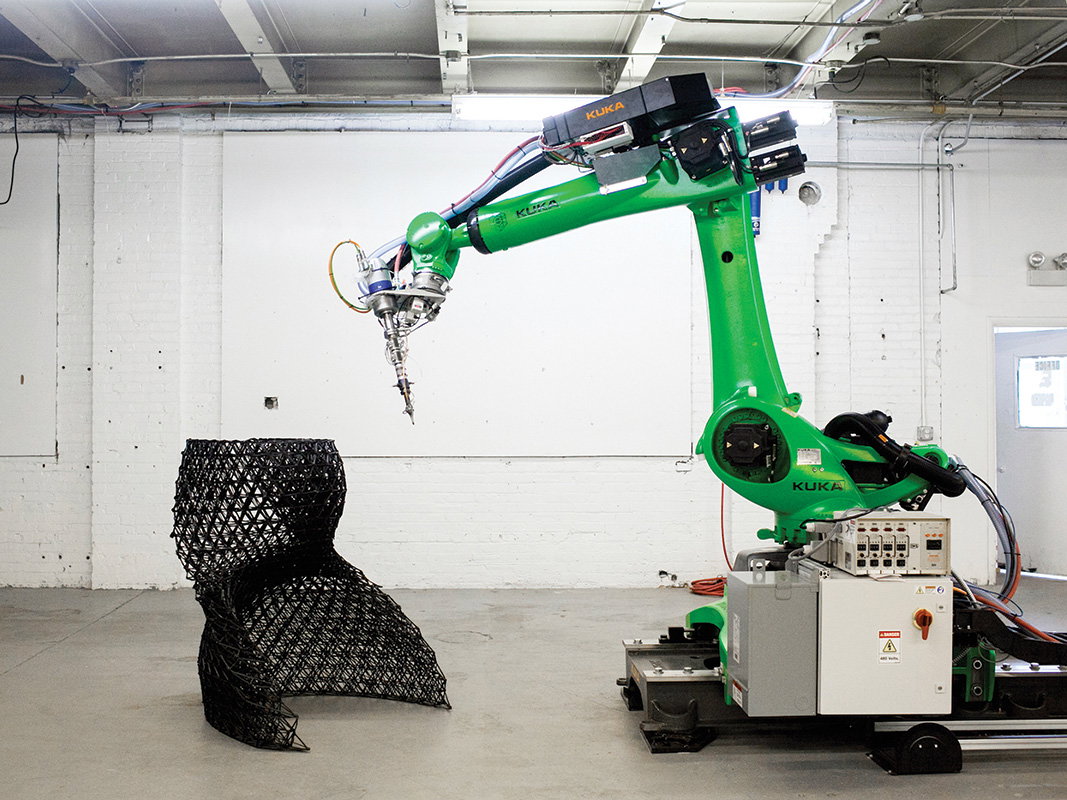
Freeform 3D wall printing
Branch Technology has developed a systemic approach to 3D printing mesh structures that function as the backbone of a wall assembly. The Cellular Fabrication (C-Fab) process is based on the knowledge that composite structures, such as human bones and trees, are common in nature. In the C-Fab structures, optimized geometries are imparted strength and functionality by the mesh material, allowing exterior and interior surfaces to be finished in any fashion. C-Fab is made possible by a free-form printing process that is not constrained by the slow, layer-upon-layer manufacturing method of traditional 3D printing. The printing head is connected to a 12.5' (3.8 m) robotic armature that slides along a 33' (10.1 m) rail and is capable of printing walls up to 58' (17.7 m) in length. Branch Technology’s algorithm generates both the spatial data and robot-driven motion to build complex geometric structures without the need for support scaffolds. The free-form nature of the approach encourages architects and designers to explore dynamic forms as well as their structural implications, while minimizing the amount of material employed.
ABS plastic, carbon fiber
Construction of lightweight shelters, walls, furniture, pavilions, and sculptural objects
Can print 3D matrix up to 25’ (7.6 m) wide and 58’ (17.7 m) long
Cellular construction optimizes material resources, strength-to-weight ratio
Currently focused on wall construction; not yet used to fabricate roofs
3D printing of composite structures for whole buildings
Branch Technology